

Understanding Your Cat's Body Language
Key Takeaways
- Cats communicate constantly through body language, not just sound — learning to read the full picture deepens your bond.
- No single cue means the same thing in every situation; always read tail, ears, eyes, whiskers, posture and sounds together.
- Tail position is one of the clearest signals, from a confident high tail to a fearful tucked or puffed tail.
- Once you can read your cat's body language, you can respond in a way that keeps them feeling safe, respected and understood.
Cats communicate constantly through body language rather than sound. Most owners catch only the obvious signals — the purrr, the hiss — while missing the subtler cues that tell the real story. Cat behaviour is a full-body conversation: tail, ears, eyes, whiskers, posture and sounds all work together to express how your cat is feeling. Learning to read the whole picture is one of the most rewarding things a cat parent can do. This guide walks through the key signals of cat behaviour so you can understand what your feline friend is really telling you, and respond in a way that makes them feel right at home.
Why Context Matters When Reading Cat Body Language
Before breaking down individual signals, it helps to understand one foundational principle: no single cue means the same thing in every situation. The same posture can mean different things depending on what is happening around the cat. A tail flick during play is not the same as a tail flick during a standoff with another animal. Understanding cat behaviour means reading several signals together rather than relying on one. Cats body language is always contextual — a relaxed cat will usually show calm cues across their whole body, while a stressed cat will show tension in multiple places at once. The more you observe cat behaviour, the more fluent you become in your cat's unique dialect.
For a deeper dive, see our guide to understanding your cat and our series on cat behaviour explained.
Cat Tail Language: What Different Positions Mean
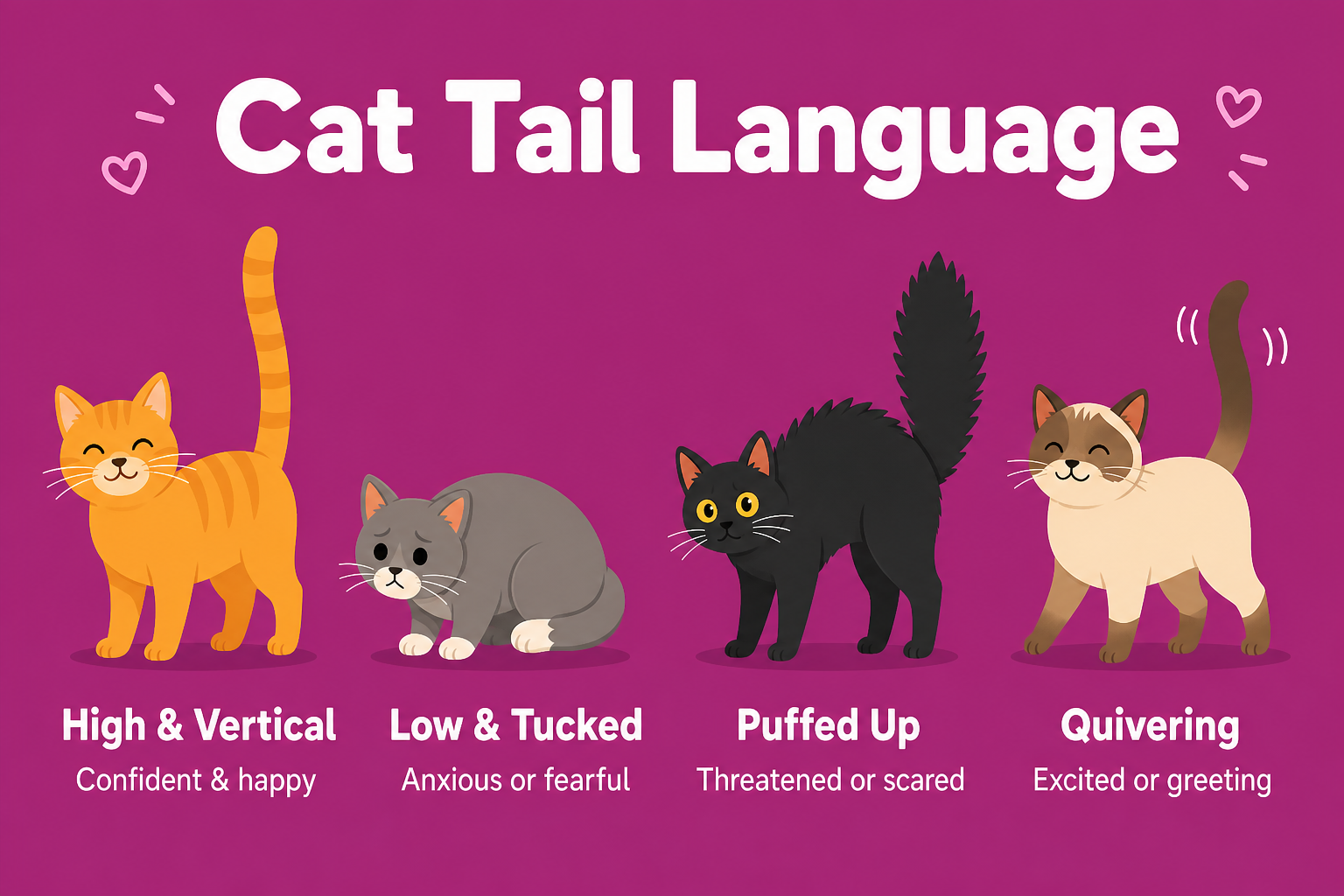
The tail is one of the clearest and most-searched body language cues a cat has. Cat tail position meaning comes down to a few common positions, each telling you something different about your cat's mood.
- High and vertical: a confident, happy cat, often offering a friendly greeting.
- Low and tucked: an anxious or fearful cat trying to appear smaller and less noticeable.
- Puffed up: a threatened or startled cat, often feeling defensive or scared.
- Quivering upright: an excited, happy cat — often a sign of a warm welcome.
- Swishing or thrashing: an overstimulated or irritated cat; give them space.
Reading cat tail body language is a great starting point, but always pair it with the other cues below for the full story.
What Does Your Cat's Ears, Eyes, and Whiskers Say?
Your cat's face is a constant broadcast of emotion. The ears, eyes and whiskers each contribute to the message.
Ears
- Forward and relaxed: alert, curious and content.
- Flat sideways ('airplane ears'): irritated, anxious or overstimulated.
- Pinned flat back: frightened, angry or in pain — give space.
Eyes
- Slow blinking: a sign of trust and affection — try blinking slowly back.
- Wide open with large pupils: excited, startled or aroused; can also signal fear.
- Half-closed: a relaxed, trusting cat.
Whiskers
- Forward and fanned: curious, interested and engaged.
- Relaxed and to the side: calm and content.
- Pulled back tightly against the face: anxious or fearful.
Full-Body Posture: Open vs. Defensive Signals
Cat behaviour is written across the whole body. A cat's posture tells you a great deal about how safe they feel in the moment, and reading it is a core part of understanding cat behaviour. Cats behaviour is best read as one connected picture — posture, tail, ears and eyes all reinforcing each other.
- Relaxed, stretched-out posture: a cat that feels safe and unthreatened, often exposing their belly — a sign of deep trust.
- Crouched, tightly-held posture: fear or discomfort, as the cat tries to appear smaller.
- Arched back with fur raised: a defensive or startled cat; cat body language arched back typically signals a threat response.
- Standing tall, leaning forward: an alert, confident or curious cat.
- Rolling onto their back: comfort and trust — though not always an invitation for a belly rub.
Other Physical Signals: Kneading, Bunting, and Rubbing
Some of the sweetest signals in cat behaviour are the physical ones. Kneading — that rhythmic paw-pressing into a soft surface — is a leftover comfort behaviour from kittenhood, a sign your cat feels safe and content. Bunting, when your cat gently bumps their head against you, is a way of marking you with their scent and claiming you as their own. Rubbing along your legs is the same idea — affectionate, claiming and reassuring all at once. To learn more, read about
To learn more, read about why cats knead.
Vocalisations and Sounds: What Your Cat Is Telling You
Sound is the layer most owners notice — but it is only part of the conversation. A purrr usually means contentment, though cats may also purr when self-soothing. Meows are almost always directed at humans, not other cats; a short meow is a greeting, while a long, drawn-out one can be a demand. Chattering — that quick, teeth-clicking sound at a bird or insect — is excitement and frustration mixed together. Hissing and growling are clear warnings: back off and give your cat space. Explore more in our guide to
Explore more in our guide to cat vocalisations and discover how cats purr.
How to Respond to What Your Cat Is Telling You
Reading the signals is only half the journey. Once you understand what your cat is saying, the question becomes: what should you do about it? Here is how to turn identification into action.
- If your cat shows relaxed, confident signals — high tail, slow blink, forward ears — offer gentle interaction, play or a favourite treat.
- If your cat shows defensive or fearful signals — tucked tail, pinned ears, crouched posture — give them space and a safe retreat. Never force contact.
- If your cat is overstimulated — swishing tail, dilated pupils, twitching skin — pause play and let them calm down before resuming.
- If your cat bunts or rubs against you, return the affection gently; it is their way of saying you belong to them.
- If signals change suddenly or your cat shows pain cues — hunching, hiding, vocalising when touched — consult your vet.
Understanding how kittens communicate can also help you read younger cats; see our guide on kitten behaviours and ways of communicating.
The more you listen, the deeper the bond grows
Every flick of the tail, every slow blink, every purrr is your cat talking to you. At WHISKAS®, we believe in nurturing the nature in every cat — and that starts with understanding them. Explore the full WHISKAS® cat food range or browse more of our cat care and health articles to keep feeding their curiosity, one signal at a time.
Frequently Asked Questions
Yes, kittens use many of the same signals — tail position, ear position, purring and posture — but they can be more exaggerated and less controlled. A kitten's body language may also shift more quickly as they learn about the world. With time and observation, the same reading principles apply.
Cats adjust their behaviour based on familiarity, trust and the energy of the person nearby. A cat may be relaxed and confident with one family member but more reserved or defensive with a stranger. This is normal — your cat is simply reading the room and responding to what feels safe.
Yes. Cats can show mixed signals when they are experiencing conflicting emotions, such as overstimulation during petting. A purring cat with flattened ears may be content but reaching their limit. When signals conflict, it is usually wise to give your cat a break and let them reset.
The core signals are similar across cats, but individual personality, breed and upbringing all play a role. Some breeds are naturally more vocal or expressive, while a shy cat may show subtler cues. The more you observe your own cat, the better you will learn their unique dialect.
Yes. Cats often hide pain, but body language can offer clues: hunching, hiding, reduced grooming, a tucked tail, flattened ears, or vocalising when touched can all signal discomfort. If you notice sudden changes in posture or behaviour, consult your vet — early attention makes a real difference.